AI Accelerates Output. It Doesn’t Automatically Accelerate Coordination.
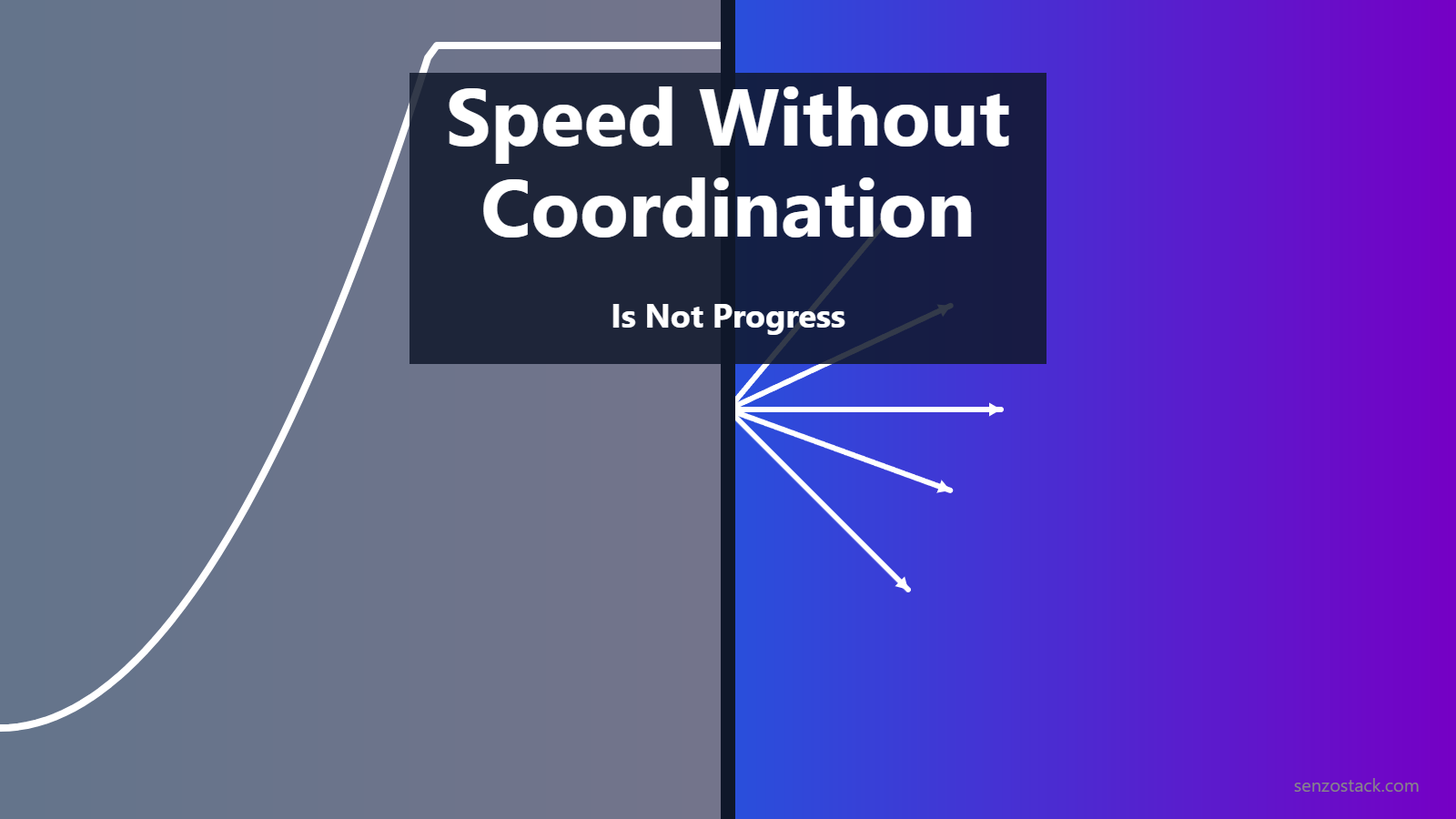
As AI accelerates development, coordination problems become more visible. Speed without coordination creates organizational damage.
By Issam Gharios
For the past two years, the AI conversation in software engineering has mostly focused on one thing:
productivity.
How much faster can developers write code?
How many tickets can a team close?
How much headcount can organizations avoid adding?
And to be fair, the gains are real.
AI-assisted development is accelerating implementation dramatically. Engineers can scaffold systems, generate integrations, write tests, refactor code, and build internal tooling faster than ever before.
But software delivery was never constrained only by writing code.
The real constraint has always been coordination.
The Wrong Bottleneck
For years, engineering organizations optimized around developer throughput because implementation time was expensive.
Now implementation is becoming cheaper.
A single engineer with agents can produce the output that once required an entire team.
But increasing output does not automatically increase alignment.
In fact, many organizations are discovering the opposite.
As AI accelerates development, coordination problems become more visible.
You start seeing:
- conflicting architectural decisions
- duplicated work
- review fatigue
- validation bottlenecks
- delivery drift
- unclear ownership
The anti-patterns that previously took months to surface now appear within days.
AI is not removing organizational problems.
It is compressing the timeline in which they become visible.
Coding Faster Is Not the Same as Engineering Better
One of the biggest misconceptions in AI-driven development is assuming software engineering is primarily about code production.
It isn’t.
Writing code was often the most time-consuming activity.
It was not necessarily the hardest one.
The hard parts of engineering are:
- making decisions
- managing tradeoffs
- maintaining system coherence
- validating assumptions
- understanding user impact
- coordinating across functions
As agents take on more implementation work, humans spend more time doing engineering.
More output means:
- more decisions
- more reviews
- more prioritization
- more cognitive load
Organizations that fail to adapt to this shift will mistake speed for progress.